Site Search
- resource provided by the Forum Network Knowledgebase.
Search Tip: Search with " " to find exact matches.
One year from now the 2020 Census will be in full swing. This nationwide, constitutionally-mandated count, conducted once every ten years, is our opportunity to ensure that New Jersey residents are accurately counted to secure the resources needed to support our communities. Nationally, more than $800 billion in federal funding as well as fair, proportional voting representation are at stake. In New Jersey, allocations from 16 federal programs including Medicaid, education grants, and even highway planning and construction are allotted based on the census count. This totaled over $17 billion in 2015.
But the 2020 Census is facing unprecedented challenges, including years of underfunding, a climate of fear, the challenges of the first “high tech” census, and the potential addition of an untested citizenship question. That means we will all have to work together to overcome these challenges and help achieve a fair and accurate census to ensure that the hardest-to-count communities—like people of color, low-income folks, LGBTQ people, immigrant communities, rural communities, and young children—aren’t missed. Based on the latest census estimates, approximately 22% of New Jersey’s population lives in hard-to-count areas.
CNJG joins the Funders’ Committee for Civic Participation’s Funders Census Initiative, United Philanthropy Forum and philanthropy-serving organizations around the country in asking our members to commit to supporting and encouraging a fair and accurate census.
The Census is one of our nation’s most important and consequential civic obligations. Getting it right and counting everyone ensures people and communities can thrive.
Please feel free to reach out to me or Deputy Director Theresa Jacks for information about the Council’s work on behalf of a full, fair and accurate 2020 Census.
Sincerely,
Maria Vizcarrondo, President and CEO
Council of New Jersey Grantmakers
The Future of Work and the Role of Philanthropy
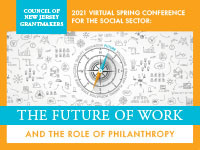
Dates: Wednesday, May 19 and Thursday, May 20
Time: 2:00 to 5:00 p.m.
One of the most valuable learning and networking events for the social sector in the state, CNJG’s 2021 Virtual Spring Conference considered the role of philanthropy in shaping how, where, and why we work.
The coronavirus pandemic has impacted and propelled the future of work in ways we couldn’t have imagined. But even before the pandemic - the automation of jobs, the gig economy, the ongoing need for reskilling and retraining, changing demographics, green careers, lack of job security and more – has been setting the stage for novel ways of working. The Spring Conference explored this new, accelerated work paradigm, it’s profound impact on New Jersey’s industries, workers and communities, and the implications for grantmakers and their nonprofit partners.
This timely and important event brought together national and local thought leaders, experts and stakeholders to share what the social sector can do to ensure a better future for New Jersey’s workforce. Attendees engaged in candid, visionary conversations around equitable labor standards and professional practices, the changing, post-pandemic workplace, strategies to fill gaps in skills, education, and opportunity, the effects of new federal job policies on workers, and much more.
Thank you for joining the Council of New Jersey Grantmakers for an exploration about what lies ahead as we prepare for and address pressing and unprecedented changes in the world of work.
Only people who registered for the Conference will be able to access WHOVA. For assistance or additional information, please contact Anna D’Elia, Manager of Programs and Learning.
CNJG's Storify content from their Signature Events.
What are the biggest needs and challenges New Jersey communities face as result of the pandemic?
- It starts with the basics: food and shelter, medical equipment such as masks for long-term care facilities, and digital access for remote education and medical screenings. For many immigrants and the undocumented community, this challenge is even greater.
- Parents of school-age children need support in navigating remote education and childcare challenges -- and balancing them with employment needs.
- People who’ve lost their jobs need to know how to find the right support services, and those services need to be accessible -- no technology or language barriers.
- Schools are having to re-imagine how they can open in the fall – if they can – with appropriate social distancing that requires changes to infrastructure and schedules.
- Organizations need support to retrofit their public spaces so they can serve the public safely.
How is CNJG leading efforts to prepare the philanthropic sector for an effective response?
- CNJG helped create the Disaster Philanthropy Playbook after Superstorm Sandy in 2012 and uses many of the lessons learned then to inform response and recovery plans for COVID.
- Almost immediately, CNJG began providing funder briefings, webinars, and other forms of information to the philanthropic community.
- With our members, CNJG created the COVID-19 Funder Learning Community for the numerous response funds that are serving New Jersey was established to:
- Get timely updates on the latest pandemic developments
- Share information about what services and help are needed most -- and where
- Explore potential strategies for effective grantmaking that matches resources to needs and avoids duplication
- Learn best practices from each other
How is the pandemic affecting New Jersey nonprofits?
- The COVID-19 crisis is having a significant and alarming financial and programmatic impact on the nonprofits relied on to care for those in need. According to the Center for Non-Profits Rapid Response Survey:
- 83% cancelled programs or events and correspondingly lost revenue
- 77% have budgetary implications related to strains on the economy
- 52% have increased demands for services
- 40% experienced a disruption in supplies or services provided by partners
- 37% have an increase in or sustained absences of staff and volunteers
- 31% have had layoffs or furloughs
- Many nonprofits lack the digital infrastructure needed to employees’ and volunteers’ sudden switch to remote work and many volunteers who do important work are no longer available.
How is New Jersey’s philanthropic sector responding to the needs of nonprofits and the people they serve?
- Many funders have streamlined the grantmaking process so nonprofits can either refocus grants or receive new funding expeditiously to provide immediate relief for those facing the most pressing situations.
- Many funders are reducing what they ask of nonprofit partners – for instance postponing reporting requirements, deferring site visits, and eliminating other demands on their time so they can focus efforts during this challenging time.
- Some are providing low- or no-interest loans or outright grants to small businesses and nonprofits to retrofit their facilities to keep essential workers and the people they serve safe.
- Several community foundations and other nonprofits have established NJ COVID-19 relief funds that make it safe and convenient for donors to give, and that direct resources to where they are needed most.
- The sector is committed to grounding its work in the Center for Disaster Philanthropy's key principles of grantmaking:
- Resilience, to improve communities holistically and make them stronger than before a disaster.
- Equity, to take historical injustices into account and inform investments.
- Sustainability, to take into account a long-term view and factor in uncertainty.
- Civic participation that equips and empowers those often left out to influence what happens in their communities.
How is CNJG responding to longstanding equity issues that the pandemic exposes and makes worse?
- Together with the Center for Non-profits in New Jersey, we put out a statement on behalf of the state’s philanthropic and nonprofit sectors, urging everyone to speak out against racism and discrimination in all forms.
- CNJG established a Racial Equity Task Force to eliminate any structural racism in New Jersey’s philanthropic community.
- Most of the larger COVID funds engaged community-based practitioners to assist in decision-making on grant awards, and CNJG is creating a local advisory group for the Learning Community.
What steps are being taken to make sure grants aren’t duplicative and that money is going where it’s needed most?
- CNJG encourages the philanthropic sector to use a shared mapping tool that shows how much money is being awarded and where. This tool helps grantmakers make informed decisions and helps to eliminate gaps in historically under-funded communities.
- The COVID-19 Funder Learning Community is a vehicle for building relationships and sharing information about what each funds is doing to support relief and recovery across the state.
What’s the best way for people to donate money for relief and recovery?
You can find a list of these New Jersey Relief and Recovery funds and their contact info here.
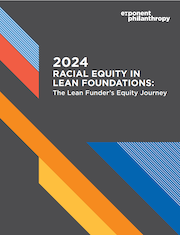
The 4th edition of Racial Equity in Lean Foundations, delves into how foundations with few or no staff are incorporating racial equity into their work to drive better decisions, achieve more equitable outcomes, and amplify their philanthropic impact.
Sample job descriptions for President and CEO or Executive Director positions at community foundations.
A growing number of foundations and philanthropists have elected to give away their money by a fixed date rather than establish perpetual foundations. The paths they’ve chosen to take, and how they chose them, provide useful tips for other philanthropists on how they can align their giving with a path that best accommodates their goals.