
Site Search
- resource provided by the Forum Network Knowledgebase.
Search Tip: Search with " " to find exact matches.
CNJG’s Newark Philanthropic Liaison, Kevin Callaghan, organized a series of webinars for our Newark Funders Affinity Group and other funders to know the specific challenges of New Jersey’s largest city responding to the COVID-19 pandemic. Guest speakers included, Mayor Ras Baraka, Newark Public Schools Superintendent Roger Leon, consulting firm McKinsey & Co., and Catherine Wilson, CEO of United Way of Greater Newark.
Facing Our Future was a landmark initiative looking at the systemic, long term fiscal challenges facing all levels of government in New Jersey. It grew out of a 2010 briefing CNJG held for members that outlined how a Governor’s budget is annually crafted. CNJG leadership worked with members to convene a group of enthusiastic former government leaders. Their collective experience crossed party lines, and many of them had served multiple New Jersey governors. This Leadership Group included 4 former Attorney Generals, 3, former Commissioners, 2 former State Treasurers, a former Director of the State Senate and a former Chief Justice of the NJ Supreme Court, in addition to leading New Jersey researchers.
Facing Our Future became an independent, bipartisan effort under the auspices of CNJG. It has produced 3 different reports that centered on the same theme.
Collaboration. Partnership. Alliance. Joint effort. Collective.
Whatever we call it - every one of us has been involved in a collaboration of some kind at some point in our lives. At the same time, both simple and complex, the definition of collaboration – the act of working together with other people or organizations to create or achieve something – means we collaborate nearly every day. To be human is to collaborate.
We’ll explore the constructs of more complex collaborations at the CNJG 2023 Annual Meeting & Holiday Gathering on December 14. Following the pre-meeting workshop, Tools for Funder Collaboration, the business meeting to elect new trustees, and the networking luncheon, the fireside chat, Sustainable, Effective, and Equitable Collaboration – A Conversation that Centers Community, will feature Nidhi Sahni, Partner and Head of US Advisory Group, Bridgespan, and Lucy Vandenberg, Executive Director, the Schumann Fund for New Jersey, to explore what makes a successful collaboration, and how collaboration strengthens the impact of funding initiatives across sectors.
The Annual Meeting is the place where the seeds of collaboration are often first sown. Consider the collaborations you’re involved with now or have engaged in previously – where did those ideas first take shape – possibly in a conversation with another funder that, like you, wanted to have impact on a particular issue, solve an entrenched problem, or explore an untried solution.
Council members collaborate in a number of ways with other funders and nonprofit organizations. As a prelude to the Annual Meeting, on November 16, we’ll learn about the Morris County Funders Group and their Mental Health First Aid collaborative partnership. This first initiative of the funders group aims to address the growing mental health crisis in young people and adults.
Over 25 years ago, CNJG began its life as a collaboration – New Jersey foundations gathered together to form a collective to learn together, build relationships, and share resources. We have several resources to inform your collaborative journey as part of the Annual Meeting resource tab.
One of our core activities has always been to share resources. As we witness the conflict and heartbreaking devastation and sadness in Israel and Gaza following the October 7 attacks, some key resources to inform your work are available through the Center for Disaster Philanthropy, the go-to resource for disaster-related giving, and the Council on Foundations. You can connect quickly with your CNJG colleagues to share additional resources via our 25 listserves, including the Disaster Response Funders listserve. Contact Director of Member Services Craig Weinrich to join listserves that interest you.
Another joint effort highlighting what happens when funders come together, this time to share their own data, is the 2023 New Jersey Philanthropy Benefits & Salary Summary Report. Thank you to CNJG members that completed the surveys to inform this report.
As part of your registration for the Annual Meeting & Holiday Gathering, you’re asked if you have or are participating in a collaboration. I think it’s safe to say the answer is “YES!” for everyone. Maybe the question we should ask as we speed toward 2024, is where are the additional opportunities for collaborations? How can I build on past or current collaborations? Who else should I invite in?
I’m looking forward to seeing you at the Annual Meeting & Holiday Gathering to further explore these ideas and questions.
Thank you to our Annual Meeting sponsors, Prudential, Victoria Foundation, Robert Wood Johnson Foundation, Devils Youth Foundation, Horizon Blue Cross Blue Shield of New Jersey and the Princeton Area Community Foundation. There’s still time – I hope you will consider sponsorship for this special event – our annual “meeting of members.”
In Partnership,
Theresa Jacks, President and CEO
Council of New Jersey Grantmakers
Deepening Philanthropic and Nonprofit Partnerships in New Jersey
Doing Good Better, a partnership of the Council for New Jersey Grantmakers and the New Jersey Center for Nonprofits, is a community of funders and nonprofits taking action against the power imbalances and racial inequities in philanthropy, nonprofits and government. Accessible, equitable, and mutually accountable relationships are primary and indisputable building blocks for a stronger society and thriving communities. Our goal is to shift the culture of the New Jersey philanthropic and nonprofit ecosystem by encouraging funders, nonprofits, and government to create shared power rooted in collaboration, mutual trust, and respect.
Doing Good Better Goals: A Framework for Change
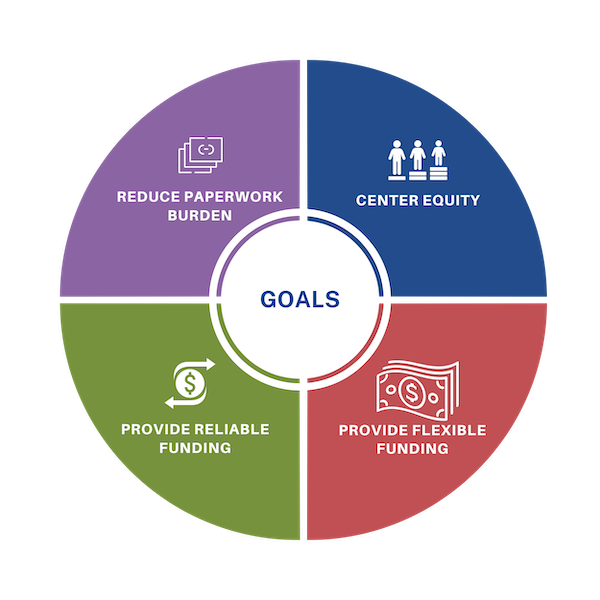
The Doing Good Better Steering Committee encourages funders to focus on and advocate for four changes that can make an immediate difference in addressing power dynamics between nonprofits and funders and maximizing nonprofit impact.
Why now?
For many years, but particularly in the context of the COVID-19 pandemic, natural disasters, and the heightened outcry for racial equity and social justice, funders have been urged to embrace more flexibility and transparency in their grantmaking. Practices such as general operating support, simplified application and reporting procedures, multi-year funding and others have been shown to level the power imbalance, advance greater equity, strengthen partnerships between funders and their nonprofit partners, and thereby improve community impact.
Many grantmakers temporarily embraced flexible practices in the wake of Superstorm Sandy and during the height of the pandemic, and these structural changes empowered nonprofits to become more resilient and have a greater impact in their communities. But while some funders have retained the flexible practices, others have reinstated previous restrictions.
In New Jersey and across the country, there is a renewed urgency to NOT return to business as usual. It’s long past time.
Doing Good Better invites all of us to reflect on how power is distributed in our partnerships, learn from our peers, and make adjustments that position all community partners for transformative, equitable change in New Jersey.
How?
Guided and informed by 50+ advisors from New Jersey who represent a broad range of perspectives from nonprofits, philanthropy, and beyond, we are approaching this work through the lens of systems change – the recognition that transformative change can only occur after power structures have been addressed collectively. Specifically, Doing Good Better encourages funders to consider the power dynamics that underpin their policies, practices, and resource flows. To do this, we provide resources and a space for dialogue centered on changes in key practices and culture shifts.
Quick practice changes you can make now.
The road to systems change begins with changing practices that impede nonprofits’ pursuit of their missions, and implement practices that demonstrate respect for and trust in the expertise and experience of nonprofits and the communities they serve. Several key practices have consistently been shown to be particularly effective. Many of these have been requested by nonprofits for quite some time, and are reflected in the principles of Trust-Based Philanthropy and Community-Centric Fundraising, among others. Here are a few practice changes you can make now:
Type of Funding
● Give multiyear and unrestricted funding, especially for grantee partners with which you’ve had long term relationships.
Access to Funding
● Create alternative processes for organizations too small to submit audits to reduce barriers to obtaining grants.
● Set aside funding pools for BIPOC-led organizations that may not have access to traditional funding sources.
Simplifying the Process
● Simplify and streamline application and reporting processes.
● Eliminate annual requests for organizational information that does not change from year to year.
Learning
● Engage with the community through participatory grantmaking that aligns with the community’s goals.
● Open dialogues with nonprofits by soliciting and acting on feedback
How do we know?
We’ve asked the experts: nonprofits, foundations, and community members who are working directly in our community as well as peers from across the country who are eliminating power imbalances in their own communities.
● Feedback from over 50+ Advisors
● The Council of New Jersey Grantmakers survey
● The Center for New Jersey Nonprofit’s survey
● The Trust Based Philanthropy Project
● The Community-Centric Fundraising movement
● Thought leaders and advocates throughout the nonprofit community
● Case studies from across the US
Public policy is a vital aspect of the work of many of New Jersey's grantmaking organizations and is an integral component of CNJG's programs and member services. CNJG's Policy Committee advise and assist CNJG in identifying issues for potential action.
In late 2023, CNJG’s Board of Trustees approved our first-ever Policy Agenda. The Policy Agenda aligns with CNJG’s 2023-2027 Strategic Plan, specifically Goal #3, Amplify Our Collective Voice. This agenda includes our approach to the work, followed by five policy priorities. Read or download the agenda.
Resource Websites
- United Philanthropy Forum Public Policy Focus
- Center for Non-Profits: Public Policy
- Council on Foundations’ Public-Philanthropic Partnership Initiative
- Council on Foundations’ Advocacy Resources
- Independent Sector: Policy and Advocacy
To learn more about what CNJG is doing to foster deeper relationships between New Jersey grantmakers and public and elected officials in Trenton and Washington, D.C., contact Theresa Jacks.
Sample disaster preparedness and recovery plans for foundations.
The Colloquium heard from an extraordinary line-up of morning and afternoon speakers, including Dave Cole, NJ Chief Innovation Officer. Clearly, the government is – and must be - on the front lines to ensure that AI ethically and responsibly benefits society. Having Dave join the panel served yet another function - introducing NJ’s philanthropic sector to the NJ Office of Innovation. One of CNJG’s important roles is connecting members with potential partners in government.
And while we’ve been deep in planning for the Colloquium, that’s not all we’ve been focused on. Over the past few months, CNJG has been at the forefront of fostering crucial dialogues between the philanthropic sector and state government, exploring philanthropy's role in civic engagement and democracy, and organizing a new convening for NJ’s nonprofit and philanthropic sector to engage in public policy collectively.
In partnership with the New Jersey Center for Nonprofits, we hosted two informational sessions for the Office of Legislative Services. In April, Center president and CEO Linda Czipo and I presented “Understanding NJ’s Nonprofit and Philanthropic Community: Role, Impact, Myths and Facts” to OLS staffers. Educating government officials and staffers about the social sector provides a grounding for future collaboration and potential partnerships. Additionally, because OLS is charged with drafting bills and conducting analysis on the impact of legislation, it is particularly important to have a good understanding of the charitable sector’s role in nurturing thriving communities. We hosted a second session in May focused on “Nonprofit Startup and Compliance Issues: A Legal Review.” Attendees came away with a working knowledge of the 501c3 family, state, and federal reporting requirements, tax rules, and an overview of the Center’s efforts to convene expert practitioners to recommend updates to the NJ Nonprofit Corporation Act in line with the modernization already done on the NJ Business Corporation Act. Attendees received continuing legal education units for session 2. Special thanks to William Engel, CNJG Policy Committee co-chair and president of the Union Foundation, and Frances A. McElhill, Archer & Greiner, long-time champion for the nonprofit sector, for joining Linda and me to present this session.
In June, we brought back one of our signature programs - Conversations with the Cabinet. Nearly 25 funders met with Commissioner Jacquelyn Suárez, NJ Department of Community Affairs, at their Trenton office to discuss current priority areas and possible opportunities for NJ’s philanthropic community to partner with state government on areas of mutual concern. We’re grateful to Commissioner Suarez and Assistant Commissioner/Director of Housing and Community Resources Janel Winter for their comprehensive presentation. As part of our discussion, we asked our friends at DCA to share examples of how philanthropy might leverage funding. One of the examples that Assistant Commissioner Winter shared was considering philanthropic investment in approved projects through the Neighborhood Revitalization Tax Credit (NRTC) program, which, while highly rated, does not receive funding due to a lack of corporate investment. If you could not attend the meeting and would like to learn more about these approved projects and other DCA programs, please get in touch with DCA Special Policy Advisor Renee Koubiadis. I’m also happy to provide an e-introduction to Renee.
On June 24, I was pleased to join several CNJG members at a funders’ briefing hosted by the Community Foundation of New Jersey and the NJ Civic Information Consortium. The Consortium provides grants to “foster increased civic engagement to organizations building and supporting local news and information in communities” in our state. During the briefing, we were introduced to Press Forward, a national movement led by inaugural director Dale Anglin to “strengthen our democracy by revitalizing local news and information.” Dale has deep roots in NJ, having served as Associate Director of Programs at the Victoria Foundation and co-chair of the Newark Funders Education Affinity Group for many years.
Looking ahead, don’t miss our first-ever Summer Joint Policy Forum – Nonprofit and Philanthropic Champions for New Jersey, on August 13, hosted by CNJG and the Center. The nonprofit and philanthropic communities are important contributors to well-informed policies for all residents of our state. This inaugural policy forum convening of nonprofit and philanthropic leaders and allies will discuss current and emerging nonprofit and philanthropic policy issues, voter engagement, and ways we can all become more involved.
As we look ahead, it has never been more important that philanthropy seeks out opportunities to partner with government, promotes civic engagement, and contributes to a healthy democracy. Among CNJG’s six policy priorities outlined in our policy agenda, we support a healthy democracy, engaged communities, and a collaborative environment between nonprofits, government, and philanthropy to move forward with this work. The connections forged during these – and future – engagements will serve as a foundation for an even more significant impact.
Sincerely,
Theresa Jacks, President and CEO
Council of New Jersey Grantmakers
This tool for unstaffed foundations includes an accountability self-assessment and a legal checklist. It is divided into nine topic sections, each of which is divided into three levels, which can help foundations tailor the tool to meet their specific interests and needs. Also included are an Excel spreadsheet to help tabulate responses, an extensive accountability resource list, and a glossary of key words and concepts used in the tool.
As we enter the spring months, I want to let you know that registration has now opened for CNJG’s 2025 Conference for the Social Sector —Stronger Together: Philanthropy & Civic Engagement!
This very special convening on June 18 will bring together funders and nonprofits for a full day of shared learning, exchange, and networking. Our conference features national and local thought leaders, and a range of experts, for a day of connection, not-to-be-missed discussion, and side-by-side learning with foundation and nonprofit colleagues.
We’re pleased to announce our keynote speaker, Dale R. Anglin, Director, Press Forward, a growing coalition of 88+ local and national funders committed to investing more than $500 million to strengthen communities through local news. Press Forward now includes 36 locally led chapters in 29 states, including one in our state — the New Jersey Civic Information Consortium.
This is CNJG's largest event of the year and your chance to join us as we examine how funders and nonprofits can work together to address and increase civic engagement, focusing on several key areas, including advocacy, local media, participatory budgeting, guaranteed income, public-private partnerships, the arts, and youth education through the lens of civic participation. Special early bird rates are available until April 12 – so please register soon.
We’re thrilled to have PSEG as our Signature Sponsor, Sixers Youth Foundation as a Collaborator Sponsor, and the Robert Wood Johnson Foundation as a Connector Sponsor. We have several opportunities available to support this very special event, and I hope you will consider sponsorship. Please reach out to Development Associate Fortunata Cuomo for more information.
In case you missed it, we recently launched the Funder Briefing Series: Making Sense of Federal Policy: Understanding What it Means for New Jersey. This series provides an overview of key issues that directly impact philanthropy, and more broadly, the charitable sector. The next session, on April 3 at 4:00 p.m., will focus on Education. There’s still time to register for the program.
And for your planning, the next briefings in this series are:
- April 10: Making Sense of Federal Policy: Understanding What it Means for NJ: Housing
- April 17: Making Sense of Federal Policy: Understanding What it Means for NJ: Media & Journalism
- April 24: Making Sense of Federal Policy: Understanding What it Means for NJ: Arts
We recorded the last three briefings in this series in case you missed them. We’re also creating a written summary for each briefing as another way for you to review the information. You must be logged in to access the recordings, summary documents, and resources.
- Making Sense of Federal Policy: Understanding What it Means for NJ: Immigration
- Making Sense of Federal Policy: Understanding What it Means for NJ: Health
- Making Sense of Federal Policy: Understanding What it Means for NJ: Environment
We believe that active participation in CNJG programs is essential for all members, their staff and trustees. Therefore, we strongly encourage you to attend and to share our programs with your staff and trustees.
The federal funding rollbacks and executive actions continue to harm nonprofits and the work they’ve built across education, healthcare, science, the arts, public media, climate, immigration, gender and racial justice, and countless other issue areas that are at stake. Foundation leaders and funders are exploring ways to respond and step up. The Trust-Based Philanthropy project, along with Grantmakers for Effective Organizations and the National Center for Family Philanthropy, coordinated a call-to-action for philanthropy to “meet the moment.” While philanthropy can’t replace federal funding, funders can “work together to move in solidarity with nonprofits, mobilize money in trust-based ways, and nurture possibility and innovation.” I invite you to join our colleagues from across the county in signing this pledge to be part of the solution.
In a recent NJ Spotlight News op-ed entitled “NJ nonprofits need your help,” Linda Czipo, President and CEO, New Jersey Center for Nonprofits, reminds us:
There is a good chance that your life has been made better because of a nonprofit… Perhaps you were born, gave birth, or received life-saving treatment at a nonprofit hospital. Maybe you learned from “Mister Rogers,” “Sesame Street” or other shows developed by nonprofits. You may have enrolled your children in childcare or after-school programs so you could go to work. You may have been uplifted, moved, or inspired by a performance at a nonprofit theater….It’s easy to take the helpers for granted; after all, they’ve always been there in our hour of need. But now it’s the helpers who need help.
It's clear we’re in a time of uncertainty, and we’re wading into deeply uncharted waters. Philanthropy has a role to play, and CNJG is here to help navigate and inform your work. In addition to the learning series, we are curating resources, information, webinars, and convenings, as well as sharing CNJG member actions, New Jersey-focused response funds, and more via the Executive Actions Response & Info tab. Please check back often. And please help us keep the information current and updated by sharing your actions and stories with Manager of Communications Shakirat Odunsi.
If you’re hearing of surveys to gather information from NJ nonprofits, please share that information with us as well. Having the latest information supports thoughtful collaboration and decision-making in times of change.
The bottom line is, we must stand together with our nonprofit partners, do our part, and take courageous action now.
On your side,
Theresa Jacks, President and CEO
Council of New Jersey Grantmakers
Multi-year Grants
Affirmation: Multi-year funds provided both reliability and breathing room for nonprofits.
Making fundamental and long-lasting change comes with the promise of reliable investments. Longer grant terms create an environment where collaborative partnerships can flourish, and trust and transparency break down power dynamics. The result is that nonprofits have the “breathing room” and financial stability to focus activities where they are most needed.
Although many funders award grants to the same nonprofits year after year, they often require submission of annual applications that request information they already have and are complex and needlessly lengthy. These processes can heighten mutual distrust. From a practical standpoint, multi-year awards reduce paperwork for both funder and nonprofit and open communication channels promoting shared goals, mutual trust, and increased overall impact.
Activities
• For funders that historically award repeat annual grants to the same nonprofit partners, shift from an annual grant/proposal cycle to a long-term, multi-year commitment with an annual outcomes/progress report in lieu of a full application.
• Tailor grant terms to suit grantee timelines and needs (negotiated outcomes and milestones).
• If data collection is required solely to meet a funder’s compliance requirements, the funder should assume this responsibility or provide sufficient funding and/or capacity for the nonprofit to meet the requirement.
Short-term Outcomes
• The number of funders making multi-year grants increases by 50% over the previous years.
Long-term Outcomes
• More funders convert an annual application process for repeat grantee partners to a multi-year commitment with an annual outcomes report at the most, instead of full proposals each year.
• Funders assume responsibility for data collection or provide sufficient funding and/or capacity for the nonprofit to meet the requirement.
• Grant terms are suited to grantee timelines and needs (negotiated outcomes and milestones).
How to Begin Doing Good Better on Reliability
Learning opportunities
• What barriers keep funders from making long-term commitments to repeat grantee partners? Are any of these barriers legal?
• What are the minimum data requirements for funders to collect from repeat grantee partners?
Pre-Work
• Address the barriers to awarding multi-year grants through tested tools.
• Learn about how multi-year grants strengthen grantee partners and improve philanthropic, nonprofit, and community impact.
• Research mechanisms funders can use to meet legal compliance requirements while gaining trust in their grantee partners.
Dates & Times
Tuesday, November 9 - 1:00 to 5:00 p.m.
Wednesday, November 10 - 1:00 to 5:00 p.m.
Tuesday, November 16 - 1:00 to 5:00 p.m.
CEOs, executive directors, CFOs, trustees, investment committee members, and finance managers of foundations and endowed nonprofits gathered together over three afternoons of learning and discussion during CNJG’s 2021 Investment Forum for Foundations and Endowments.
Attendees heard from leading asset managers, financial service institutions, professional advisors and practitioners who shared best practices and valuable insights focused on successful endowment management. Pointed, strategic, and masterful keynote speeches and educational workshop sessions explored a wide range of timely and useful topics, such as impact and ESG investing, gift acceptance policies, alternative investments, governance and due diligence, and so much more.
Sustainable philanthropy thrives on careful and skillful stewardship of the corpus. This signature event grew out of the Council of New Jersey Grantmakers’ Finance and Investment Affinity Group convenings, which have long offered CFO’s, investment committee members, board chairs and others with oversight of their endowment, exposure to a wide range of representatives, as well as thoughtful expertise and perspectives from the investment community.
Access Whova until May 16, 2022!
Registrants can access all three plenary sessions and 11 concurrent sessions on Whova for six months after the event, until May 16, 2022. You can log in with the same email and password you used to access the event. Visit Whova.
For questions, please contact Anna D'Elia, Manager of Programs and Learning.
Shifting Narratives to Change Systems
 Wednesday, December 14, 11:00 am – 3:00 pm
Luncheon & Keynote Presentation
Location: The Sheraton, Edison, 125 Raritan Center Parkway, Edison, NJ 08837
Friday, December 16, 11:00 – 12:15 pm
Virtual Workshop via Zoom
The Council of New Jersey Grantmakers thanks everyone who attended our 2022 Annual Meeting & Holiday Luncheon and the Virtual Workshop! We were delighted to see so many familiar faces, and meet many new staff and trustees of our members.
At the business meeting, members elected the new class of trustees, and heard reports about the state of the organization. After lunch and time to reconnect with each other, we heard from our keynote, Bridgit Antoinette Evans, who explained the narrative ocean in which philanthropy swims, and gave examples of how Pop Culture Collaborative is funding organizations to reframe their narratives in which they operate.
During the virtual workshop, members learned about the changemaker experience, how it affects the relationships between funders and their nonprofit partners and even grantseekers. Attendees were led through an exercise to create a journey map, and think through strategies how to examine the experiences that nonprofits have with their organizations.
CNJG members can view recordings and additional resources from the event on the resources tab, when logged in.
Philanthropic Collaboratives:
Driving Impact and Opportunity
 Thursday, December 14, 2023 - 9:00am to 3:00pm
Luncheon, Keynote Presentation & Workshop
Location: Crowne Plaza Edison, 2055 Lincoln Highway, Edison, NJ 08817
The Council of New Jersey Grantmakers thanks everyone who attended our 2023 Annual Meeting & Holiday Luncheon and the Pre-Meeting Workshop that explored Philanthropic Collaboratives: Driving Impact and Opportunity. We were thrilled to reconnect with friends and colleagues and meet new members.
At the Business meeting, the membership elected the new class of Trustees. We also honored our outgoing Board Chair, Jeff Vega, for all the incredible work he accomplished during his term. After lunch and networking time, we listened attentively to Nidhi Sahni, Partner and Head of US Advisory Group, New York, Bridgespan, and Lucy Vandenberg, Executive Director of the Schumann Fund for New Jersey in conversation about the nuances and benefits of collaboration.
At the pre-meeting workshop, Tools for Funder Collaboration, presented by John Harper, Chirlie Felix, and Waheera Mardah of FSG, members were presented multiple models of collaboration and examples of collective impact followed by an opportunity to engage in dynamic discussion to further explore the concepts.
CNJG members can view the FSG PowerPoint and additional resources from the event on the resources tab, when logged in.
Right Size Applications; Simplify Reporting
Affirmation: Paperwork hinders us all.
Duplicative or complex proposal and reporting requirements divert time and resources for both nonprofits and philanthropy, needlessly burdens nonprofit partners and siphons scarce resources away from where they are most needed. Funders can lessen the burden on grantee partners by streamlining the application and reporting processes, especially for repeat grantee partners; decreasing the required data to only the most necessary for decision-making; taking on some of the burden of data collection by gathering data from central repositories such as New Jersey Philanthropy Hub, Candid (formerly GuideStar) and the IRS; and retain and use data already collected from repeat grantees. Funders should require updated information such as annual budget, staffing, board member changes, etc., in their grant applications only when the nonprofit is the only source for this information. Collaborate with other local funders and agree to common GOS application questions and budget templates; streamline tools through technology and offer innovative ways for organizations to apply for and report out on grants; limit written requirements to information that is relevant to the request, and which moves the needle on critical social issues.
Activities
• Reduce rigidity and increase the flexibility of what nonprofits must submit for their applications in creative, egalitarian, and less burdensome ways.
• All funders right-size their application and report requirements relative to the grant amount.
• Shift from reports to conversations or other lower time-intensive means.
• Develop agreed-upon common questions for use across the philanthropy sector for general operating support grant applications.
• Explore the efficacy of using common applications for general operating support grants.
• Change site visits for compliance to goals of learning.
• Consider developing a central data repository for New Jersey nonprofits and funders, where applicants can submit and update basic information once a year, and funders can access the necessary information.
Outcomes
• 75% of funders begin to reduce the size of applications and reports relative to the size of the grant.
• 75% of funders shift from reports to conversations or other lower time-intensive means, like site visits geared to learning and relationship building.
• 50% of funders making general operating support grants accept creative, egalitarian, less burdensome applications including other funders proposals.
• Nonprofits have increased capacity to dedicate time to other activities and efforts.
How to Begin Doing Good Better on Reducing Burden
Learning opportunities
• For funders who do not right-size their applications, what are the barriers to reducing paperwork?
• Who is making the decisions about the application and reporting requirements, and how can they be reached to encourage change? How can we involve more board members of funders in this effort?
• For funders who require reports, determine what is “nice to have” vs. what is needed and used and consider eliminating the rest; what are expeditious ways to collect data including accepting other funders’ reports?
• Which funders who make multi-year grants require a full application for the first year and updates for subsequent years?
Pre-Work
• For funders who already report tailoring their applications, consider how to further simplify processes for grantees; share these practices with other colleagues in philanthropy.
• Learn how information is collected without burdening the applicant.
• Review and implement recommendations already provided by nonprofit networks and philanthropy-serving organizations for concrete examples such as centralized document repositories; allowing nonprofit partners to re-use other proposals and reports; holding check-in meetings in lieu of written reports; and other helpful practices.
• Seek promising practices of funders who use site visits as opportunities to build trust and understand the programs and organizations they support instead of as compliance reviews.
Notes:
See, for example, SMU DataArts (formerly the Cultural Data Project), https://culturaldata.org, a nationwide research and data repository for the arts and cultural community. DataArts serves as a collector and clearinghouse for a wide array of data, which funders can access instead of requiring nonprofits to provide it separately.
It’s summer – and that means summer reading! Whether you’re reading at home or in the coffee shop, at the beach, or while traveling by train or airplane, I'm thrilled to share a collection of summer reading recommendations from CNJG’s Board of Trustees and staff. While some recommendations speak directly to philanthropy and the social sector, others explore leadership, civic engagement, economics, and personal growth, all offering insights and ideas to excite our curiosity and inspire us.
Board Chair Craig Drinkard has been re-reading the timeless classic Good to Great by Jim Collins. Craig shared that so much more is resonating this time around as he re-reads it. The first time he read the book, the theory is what stood out; this time it’s deeper, more strategic, and thought provoking, with fresh insights gained during this second look. This book is worth a read for everyone dedicated to leadership and organizational improvement.
First Vice Chair, Justin Kiczek continues to be inspired by our recent convening, 2025 Conference for the Social Sector - Stronger Together: Philanthropy & Civic Engagementand recommends Habits of Heart and Mind: How to Fortify Civic Culture from Our Common Purpose - a publication he says has been a "continued source of wisdom and good ideas" and passes on to pretty much anyone he knows! He also follows two Substack columns focused on civic culture and renewal: Daniel Stid’s The Art of Association and Gabe Lerner’s Democracy Notes.
Treasurer Catherine Wilson has been diving into a diverse reading list including Autocracy, Inc.by Anne Applebaum, The Art of More: How Mathematics Created Civilization by Michael Brooks, and The Heat Will Kill You First: Life and Death on a Scorched Planet by Jeff Goodell.
Also from our board members:
Paul DiLorenzo is catching up on his back-dated New Yorker magazines and especially loved a story called Amelia Earhart’s Reckless Final Flights.
Maisha Simmons recommends checking out this insightful blog post: The Challenge and Opportunity for Funder and Nonprofit Listening Right Now.
Tammy Rice Herman has been reading the weekly blog, "Better Allies" where author Karen Catlin shares five simple actions each week to create a more inclusive and engaging workplace. You can sign up here to receive the blog every Friday.
Margarethe Laurenzi recommends listening to Ann Patchett at Parnassus Books talk about all the great books being written that serve as a rebuttal to the idea that literary fiction has lost its way.
Jasmyne Beckford has been enjoying reading Choosing Purposeful Alignment: The Messy Middle of Transformation. The book really speaks to her, “because it’s all about how growth happens in that uncertain, messy middle where you have to keep choosing what aligns with your values.”
Lucy Vandenberg’s summer reading and all year round includes her “daily devouring of The New York Times and NJ Spotlight!”
The CNJG team has a few reading recommendations for you too!
Senior Director, Member Experience, Craig Weinrich recommends Doughnut Economics by Kate Raworth, who argues that GDP should no longer be the sole indicator for a nation’s (and the world’s) economic health. Measuring something as complex as an economy needs an updated tool – thus the doughnut model that includes social and ecological benefits and harms, resulting from economic activity.
Manager of Programs and Learning, Chanika Svetvilas is currently reading Systemic: How Racism Is Making Us Sick by Layla Liverpool. She notes Liverpool's observation that “Racism is an insidious threat to our health precisely because it is so easily overlooked or, in some cases, perhaps willfully ignored.”
Manager of Communications Shakirat Odunsi picked up two books at United Philanthropy Forum’s UnConference last month: Future Good: How to Use Futurism to Save the Worldby Trista Harris and A New Era of Philanthropy by Dimple Abichandani. These picks reflect her interest in how our sector can evolve and adapt. Harris's work explores how futurist thinking can be applied to social change, while Abichandani's book examines the transformation happening in philanthropic practices and approaches. Both seem perfectly timed for those of us thinking about where philanthropy is headed next.
For my own summer reading, I've been reassured by reading Who is Government? The Untold Story of Public Service edited by Michael Lewis – the stories of the real women and men working in the public sector without bravado and bluster. These are the civil servants that oversee our veterans’ cemeteries, explore our universe, hunt down cyber criminals and preserve our archives. These unsung heroes do the daily, unseen, yet necessary work of the people. “Although they often go unnoticed, public servants are the heartbeat of our nation.”
I also recently read, Meditations for Mortals - Four Weeks to Embrace Your Limitations and Make Time for What Counts by Oliver Burkeman. I plan on re-reading it so I can gain some deeper insights during my upcoming sabbatical.
Yes – that’s correct - I will be on sabbatical beginning Monday, August 11, and will return to the office on Tuesday, October 14! I started my journey at CNJG in May 2008. I’m grateful to the CNJG Board of Trustees for giving me this opportunity, and grateful to an incredibly dedicated and competent team that will ensure work of the Council continues during my absence! Thank you!
Special thanks to Craig Weinrich, who will be the senior executive in charge, while I am on sabbatical. Please feel free to reach out to Office Manager Dana Schwartz, as well, at [email protected].
I'm struck by the breadth and depth of what our community is reading, from civic engagement and economic models to health equity and the future of philanthropy. These recommendations reflect the commitment to continuous and shared learning that makes our CNJG community so special. I’m looking forward to exploring some of these recommendations during my time away. And in case you missed it, the annual CNJG 2024 President's Report also celebrates what makes our CNJG community so special!
With appreciation,
Theresa Jacks, President and CEO
Council of New Jersey Grantmakers
From Moment to Movement: Upending Traditional Philanthropy
Dates & Time:
Monday, December 13 - 2:00 to 3:30 pm -- Annual Meeting Workshop
Tuesday, December 14 - 12:30 to 2:00 pm -- Business Meeting & Keynote Presentation
The Council of New Jersey Grantmakers thanks everyone who attended our 2021 Virtual Annual Meeting & Holiday Gathering.
The 2021 Annual Meeting, From Moment to Movement: Upending Traditional Philanthropy, tackled how we can implement practices based in trust, confront uneven power structures, and advance equity in the philanthropic sector.
Our Annual Meeting Workshop on December 13 explored how two foundations, The Claneil Foundation and Weingart Foundation, are using general operating support, multi-year funding, and transparent communication and feedback to build strong, effective relationships with nonprofit partners. Afterwards, funders discussed where they want to move the needle in their own organization, and the major barriers to implementing those changes.
On Day 2, we heard an inspiring keynote presentation from Marcus Walton, President and CEO of Grantmakers for Effective Organizations (GEO). Marcus kicked off the keynote by sharing critical insights for building trust within and outside your organization. He then engaged in a candid conversation with CNJG President and CEO Maria Vizcarrondo, and answered questions from attendees, on how to reach communities, rethink traditional grantmaking practices, and advance racial equity within philanthropy and New Jersey.
Philanthropy needs to change to meet this moment. Breaking away from ingrained structures and replacing outdated “best practices” with strategies based in trust and power sharing is a long and challenging road for many grantmaking organizations. There will be growing pains. But, during this year’s Annual Meeting & Holiday Gathering, we heard about effective strategies from courageous leaders that have made these changes possible. Join us in 2022 as we continue to rework, reimagine, and operationalize new practices that better serve our partners and communities.
CNJG members can view recordings from the event and additional resources when logged in.
This weekly conference call series welcomed New Jersey-based grantmakers along with national funders and provided an opportunity for grantmakers to hear from a wide range of experts in the field of disaster philanthropy. This series started on November 5, 2012, one week after Sandy struck New Jersey, and continued through March 25, 2013. The written summaries of each recording are listed below.
In response to the murders of George Floyd, Breonna Taylor, Tony McDade, Ahmaud Arbery, and countless other Black individuals, we have seen a call to end systemic racism, police brutality, and injustice. To explore philanthropy's role in fighting against racism and injustice, CNJG is sharing information about upcoming programs that we and our Philanthropy-Serving Organizations are presenting and other resources below. While some programs or resources have been organized in direct response to recent protests and calls for action, all are part of a longer conversation on racism in our country and within our sector. As CNJG weaves equity into all of our work, we look forward to continuing these conversations with you.
We realize this is not a comprehensive list, and we are posting items that CNJG staff sees, which is not nearly enough. We ask that our members, especially those who are black and brown, to help us find articles written by, resources created by, and programs led by people of color. Share those resources by emailing us. This page is just a part of our work in equity. We created this page as one starting point for New Jersey’s philanthropic community to engage in conversations, do background reading, attend programs, learn, and take action.
For those members interested in continuing the conversations, we invite you to join our Racial Equity listserve, by emailing Craig Weinrich. On that listserve, members can share information, resources, and opportunities that are helpful to the funding community.
Visit these Websites
Asian Americans/Pacific Islanders in Philanthropy (AAPIP) Resource Directory
This Supporting API Communities Resource Directory was developed to mobilize the philanthropic sector towards meaningful action in the midst of heightened violence and hate targeting Asian American communities.
Participatory Grantmaking
A curated list of resources and articles from Candid on the movement of participatory grantmaking that engages the community in the grantmaking process.
The Power of Asset Framing: A Conversation with Trabian Shorters
This blog post by the Skillman Foundation contains a series of short videos by Trabian Shorters, founder and CEO of BMe Community, who describes shifts in narrative that all philanthropy should consider.
Putting Racism on the Table
This site created by the Washington Regional Association of Grantmakers is the inspiration for CNJG’s Race, Racism and the Ramifications for Philanthropy Series.
Race to Lead Series
A site with reports and surveys on the racial leadership gap in the nonprofit sector.
Stanford Social Innovation Review
The Struggle to Overcome Racism, a list of resources to help leaders of social change and activists.
Trust-Based Philanthropy Project
A peer-to-peer learning and advocacy initiative to make philanthropy more based on trust.
Igniting Equitable Systems Change Together
Date: Thursday, May 26
Time: 1:00 to 5:00 p.m.
On May 26, the Council brought together recognized thought leaders from philanthropy and nonprofits for a conversation exploring how the social sector can advance systems change.
Grantmakers and nonprofits grapple with complex, structural issues every day, and take on the difficult questions to move our collective work forward.
During a dynamic discussion, panelists shared strategies to empower proximate leaders, remove structural barriers and build the capacity of grassroots organizations, and shift mental models to challenge assumptions and strengthen nonprofit-funder relationships. After the panel, case study presenters highlighted three local examples of systems change, emphasizing the importance of cross-sector collaboration, collective action, and community engagement. Then, attendees gathered together for small group discussions to unpack key takeaways and discuss their own successes and challenges with systems change.
One of the most highly regarded convenings for social sector leaders in the state, the 2022 Virtual Spring Colloquium considered the power and cultural shifts needed to advance systems change through philanthropic and nonprofit partnership.
Attendees can revisit Whova to access event features such as session recordings, exhibitor virtual booths and sponsor pages, NJ Poetry Out Loud performances, and more.
| Agenda | |
| 1:00 - 1:30 pm: | Opening Session Featuring Sponsors & Exhibitors |
| 1:30 - 2:00 pm: | Break & Independently Visit with Sponsors & Exhibitor Virtual Booths |
| 2:00 - 3:30 pm: | Panel Discussion & Case Study Presentations - Igniting Equitable Systems Change Together |
| 3:30 - 4:00 pm: | Small Group Discussions |
| 4:00 - 4:15 pm: | Break & Independently Visit with Sponsors & Exhibitor Virtual Booths |
| 4:15 - 5:00 pm: | Networking Reception Featuring NJ Trivia |