
Site Search
- resource provided by the Forum Network Knowledgebase.
Search Tip: Search with " " to find exact matches.
In Q2 2021, our foundation awarded 29 grants totaling over 12 million dollars. Of these, 9 grants were new, while 20 were renewals. Our Q2 grantmaking aligns with our updated funding model, which focuses our work on identifying and fueling the scale of cost-effective programs and solutions that accelerate improvement in key academic and socioemotional outcomes for all children. Inspired by venture philanthropy, the model puts an emphasis on grantmaking and strategic support that unlock innovation, evidence, and growth.
In Q1 2022, our foundation awarded 41 grants totaling over $12 million dollars. Of these, 17 grants were new and 24 were renewals.
Our first quarter grantmaking aligns with our updated funding model, which focuses our work on identifying and fueling the scale of cost-effective programs and solutions that accelerate improvement in key academic and socioemotional outcomes for all children. Inspired by venture philanthropy, the model puts an emphasis on grantmaking and strategic support that unlock innovation, evidence, and growth.
In June, the Montclair Fund for Women announced it has awarded $71,000 in annual grants to area nonprofit organizations providing services to women and girls.
Board of Trustees President Tanya Poteat said, “We are proud to support the vibrant and necessary work of the following non-profit organizations providing services to women and girls in Montclair and West Essex.”
The Head of Operations will operate at both the strategic and tactical levels - able to see the big picture while also rolling up their sleeves to draft policies, support organizational legal and compliance work, implement solutions, and manage day-to-day execution. The role sits at the intersection of the organization’s entities and will be responsible for streamlining shared services and ensuring strong coordination across areas such as CRM systems, vendor management, technology, office space, and security.
Reinvestment Fund is seeking a Program Manager to join our current team to support the expansion and implementation of America’s Healthy Food Financing Initiative (HFFI). Reporting directly to the Managing Director, Equitable Food Systems, the Program Manager will work with internal and external stakeholders to design and implement the HFFI Partnerships Program and to support successful implementation of the overall HFFI program.
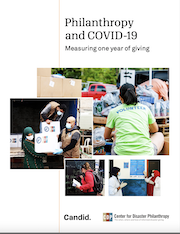
As of February 22, 2021, the coronavirus pandemic has claimed the lives of more than 2.5 million people around the world, with an additional 110 million people infected. And while data such as this serves an enormous purpose in understanding the scale and scope of a disaster, aiding experts in determining needs and directing resources, it remains far from the complete picture of the impact of COVID-19 on humanity.
Philanthropy’s response to the COVID-19 pandemic demonstrates that not only can donors be exceedingly generous in a crisis, but they can lead through trust and courage. In this new report, the Center for Disaster Philanthropy and Candid recognize this leadership, as demonstrated by increased overall giving, even if too little of it is in the form of unrestricted grants and funds directed toward Black, Indigenous, and other communities of color. There remains much to be done, especially regarding support for programs that deliver the policy and system changes necessary to redress generations of inequities.
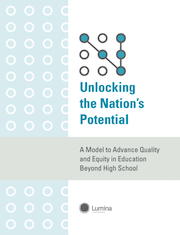
A report from Lumina Foundation and its Quality Credentials Task Force calls for a coordinated national effort to ensure equitable access to quality postsecondary education in the United States.
The report, Unlocking the Nation's Potential: A Model to Advance Quality and Equity in Education Beyond High School (32 pages, PDF), found that the current U.S. system of degrees, certificates, industry certifications, and other credentials lacks a comprehensive definition of quality as well as the kind of up-to-date indicators needed to drive improvements in policies and practices. To help guide efforts that ensure access to high-quality educational opportunities for students of color and advance racially and economically just outcomes, the task force — which includes nearly two dozen education, policy, and workforce development leaders — proposes a model based on a shared understanding of what a quality credential is, as well as institution-based curricular changes and systemic reforms at the federal and state levels.
Giving circles and other forms of collective giving (hereafter referred to as GCs) have grown significantly in visibility and popularity over the past 15 years. Often started by donors, they are widely understood to be highly flexible, democratic, do-ityourself vehicles for giving. Previous research has illuminated the positive impact that participation has on the giving and civic engagement of donors. Until recently, however, our understanding of the scope and scale of GCs was 10 years out of date!
This research presents an updated understanding of the current landscape of GCs and similar models of collective giving or giving collaboratives in the United States. This research comprises the first of a three-part inquiry, which also looks at research underway related to the impact of participation in GCs on donor giving and civic engagement, and a study of the relationships between GCs and their hosting organizations.
Snapshot: Trends and Strategies to Engage Employees in Greater Giving is the third edition in a series of reports developed by America's Charities since 2000.
Key findings include:
- The evolution of the current employee giving model continues toward aligned, branded initiatives that offer charitable choice and that are integrated with other employee engagement activities.
- Companies recognize the benefits – employer, employee, and community – of a strong giving program.
- Digital culture is driving many of the changes in employee giving.
- “Workplace giving” is evolving a full spectrum of employee engagement initiatives.
- Companies are creating a new giving model to attract younger employees and to ensure their programs remain relevant and vibrant.
The New Jersey Arts and Culture Recovery Fund has awarded $1.3 million in grants to 68 nonprofits across the state in an effort to help them recover from the devastating effects of the pandemic.
This is the second round of grants awarded by NJACRF, which is hosted by the Princeton Area Community Foundation. Earlier this year, the fund provided $2.6 million in grants to more than 100 other arts, culture and historical nonprofits statewide.
COVID-19 shuttered venues and forced furloughs and layoffs of more than half of the state’s creative workforce. The state’s nonprofit arts industry reported pandemic-related losses of more than $100 million as of December.
In response to the needs of the arts community, NJACRF was established last year with a gift from the Grunin Foundation, based in Toms River. A coalition of funders quickly followed with their support, to ensure the recovery of the industry.
Approximately 45 million foreign-born individuals from all over the world reside in the United States, more than in any other country, comprising nearly 14 percent of the U.S. population.
A 2021 poll from the Cato Institute shows 72 percent of respondents consider immigration to be good for the nation. Yet, many people continue to have complicated and conflicting opinions on the issue, often based on a lack of understanding of how the immigration system operates and exacerbated by disinformation campaigns.
Research helps identify what inspires people to act, while cultural interventions and organizing affect perceptions and how we relate to one another. In this webinar, we will explore the strategies and tactics organizations are deploying to move hearts and minds in support of immigration.
COST: Free for members and nonmembers
The Camden Coalition and the Bristol Myers Squibb Foundation (BMS Foundation) today announced the first-ever recipients of the New Jersey Safety Net Innovation Program (NJ SNIP), which will provide $3.3 million in grants to 11 organizations focused on strengthening the healthcare safety net and improving health equity in New Jersey.
Awardees of the NJ SNIP grants will each receive $300,000 in funding over two years from the BMS Foundation to address the community and/or strategic capacity-building needs in their areas. The Camden Coalition will offer tailored one-on-one technical support related to project management and implementation barriers as well as other technical resources.
On this webinar, Mayor Baraka presented an update from the City, non-profit leaders, shared what they are seeing on the ground, and funding colleagues discussed the philanthropic response in Newark.
Speakers:
Mayor Ras J. Baraka
Vicky Hernandez, Executive Director, Ironbound Community Corporation
Amina Bey, Executive Director, Newark Emergency Services for Families
Irene Cooper-Basch, Executive Officer, Victoria Foundation
Catherine Wilson, President and CEO, United Way of Greater Newark
Webinar Video
On this webinar, funders were briefed on how the CARES Act can help nonprofit organizations during COVID-19, heard an update on testing and public health needs from the city, and were informed on the response and greatest needs in Newark hospitals.
Speakers:
Brandon McKoy, President, New Jersey Policy Perspective
Dr. Shereef Elnahol, President and CEO, University Hospital
Dr. Mark Wade, Director, City of Newark Department of Health and Community Wellness
Webinar Video
On this webinar, Newark funders discussed the childcare practice and policy during COVID-19 and heard front line observations on matters of mental health and domestic violence.
Speakers:
Ceil Zalkind, President and CEO, Advocates for Children of New Jersey
Beverly Lynn, CEO, Programs for Parents
Maria Ortiz, Executive Director, Student Life, Newark Board of Education
LaKeesha Eure, Director, Shani Baraka Women’s Resource Center and Chair, Newark Anti-Violence Coalition
Webinar Video