
Site Search
- resource provided by the Forum Network Knowledgebase.
Search Tip: Search with " " to find exact matches.
How the government can partner with impact investors to unleash new capital, talent and energy for maximum impact.
We know that funders face many challenges when attempting to make the case within their institutions for the value and importance of investing in immigrant communities. We also know that moving money to immigrant-led and immigrant-centered organizations can help foundations advance their strategic priorities, whether they relate to immigration explicitly or not.
GCIR has developed a new messaging toolkit (which will be released ahead of the webinar) designed to support funders, especially those who are navigating hostile external environments, as they make the case to their leadership or peer communities for the value of supporting immigrants in their grantmaking strategies. Join GCIR staff for a strategy session in which we will:
Share compelling talking points linked to universal values and shared priorities.
Address common concerns foundation leaders may raise.
Offer concrete guidance on how to bring these messages into everyday philanthropic practice.
At the end of the session, we will have time to explore strategies for using these tools and for participants to share their experiences with making the case for supporting immigrant communities.
Cost: Free
Who may attend:
Staff and board members of foundations, corporate-giving programs, philanthropic consultancies, affinity groups, and invited governmental grantmaking agencies.
Foundation funding in support of global human rights initiatives totaled $2.8 billion in 2016, up from $2.4 billion in 2015, according to the report from Candid and the Human Rights Funders Network. The report from the Advancing Human Rights research hub found that 785 funders in 43 countries awarded 23,016 grants to 13,242 organizations working to address the root causes of injustice and inequality and ensure the protection and enjoyment of internationally recognized human rights. Twenty-one percent of those grant dollars were awarded in the form of general support grants.
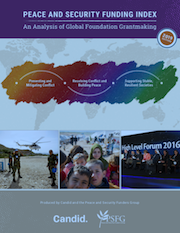
The latest edition of this study found global philanthropic support for efforts to prevent, mitigate and resolve conflicts totaled $328.2 million in 2016 from 326 foundations and 2,600 grants. Funding for peace and security remains insignificant relative to foundation funding overall, accounting for just 0.7 percent of the $32 billion given by foundations in Candid's 2016 FC 1000 data set.
The Disability & Philanthropy Forum invites you to register for the 2024 Disability & Philanthropy Webinar Series. All of our 2024 webinars will be open to the public. This collective learning journey will focus on why a disability lens is essential to addressing key social justice issues. Each webinar will engage philanthropic leaders in conversation with disability advocates about how we can move toward a more equitable, inclusive future for all.
Disability Pride, Joy, and Visions for the Future: July 11 - 1:00 - 2:00 p.m. ET
Disability and the Care Economy: September 19 - 1:00 - 2:00 p.m. ET
Disability-Inclusive Hiring: October 10 - 1:00 - 2:00 p.m. ET
Disability in Indigenous Communities: November 14 - 1:00 - 2:00 p.m. ET
All webinars are open to the public, so feel free to share with anyone you know that's interested in learning about disability inclusion, rights, and justice.
CART will be provided. If you require another accommodation to fully participate in the webinar, please note it in your registration, or contact us at [email protected].

Racial Equity Tools is designed to support individuals and groups working to achieve racial equity. This site offers tools, research, tips, curricula and ideas for people who want to increase their own understanding and to help those working toward justice at every level – in systems, organizations, communities and the culture at large.
Native Voices Rising is a joint research and re-granting project of Native Americans in Philanthropy and Common Counsel Foundation. This report focuses on the practices and challenges of community organizing and advocacy, focusing on the need for increased investment in and sustained support for American Indian, Alaska Native and Native Hawaiian communities.
The Future of Work and the Role of Philanthropy
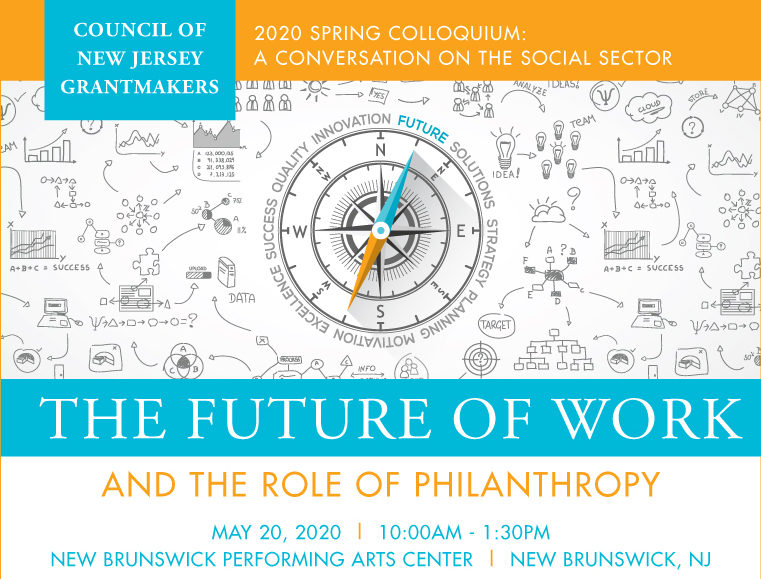
Date: This event has been postponed.
After much consideration and in light of the ongoing spread of coronavirus, CNJG has decided to postpone the 2020 Spring Colloquium, entitled The Future of Work and Philanthropy’s Role.
This was a difficult decision, but the health and safety of attendees and staff are of the utmost importance at this time. It is especially significant because our communities--and indeed our state--rely so heavily on the services and programs made possible by New Jersey’s foundations and charitable organizations. We do not want to do anything that could impede the good work being done by our philanthropic and nonprofit staff, leaders and stakeholders.
We are tremendously grateful to PSEG, our Signature Sponsor, for their continued support, and thank the CNJG Program Committee for their thoughtful guidance and ongoing assistance.
In 2004, a group of foundations came together to create a funder collaborative in support of Freedom to Marry’s state-by-state strategy to win marriage equality. Over the following 11 years, this unique collaborative and its funding partners invested a total of $153 million to support a wide range of activities across the country to change hearts and minds on a massive scale — and ultimately to deliver a historic win for equality and love.
A new case study and video tell the untold, behind-the-scenes story of this funder collaborative — how its members worked with movement leaders to develop a strategy for winning, how they persevered in their support despite enormous setbacks, and how they invested in the opinion research, state-by-state grassroots action and litigation that pushed marriage over the finish line from coast to coast. As the Civil Marriage Collaborative closes its doors in 2015, the case study and video also draw lessons from this historic victory for foundations supporting other social justice causes.