
Site Search
- resource provided by the Forum Network Knowledgebase.
Search Tip: Search with " " to find exact matches.
Recognizing that small businesses and entrepreneurs generate jobs, create diverse communities and are vital to prosperous cities, JPMorgan Chase announced this week that it is providing more than $1.5 million to four nonprofit organizations in New Jersey.
The goal, JPMorgan Chase officials said, is to help support diverse entrepreneurs and increase their access to capital, mentorship, technical assistance and other critical resources needed for business growth and scale.
Although co-funding is not a new idea recent efforts have contributed to a more sophisticated understanding of how to ensure that co-funding arrangements have the desired impact. This report is part of Grantmakers for Effective Organizations' Scaling What Works initiative.
The Bunbury Fund of the Princeton Area Community Foundation awarded more than $1.4 million in grants in 2021 to local nonprofits to help build their internal capacity.
“The Bunbury Fund’s mission is to strengthen the ability of nonprofit organizations to do their best work,” said Jamie Kyte Sapoch, a Community Foundation Trustee and Advisor to the Bunbury Fund. “We also believe it’s important to develop meaningful relationships with the nonprofit partners that we support. There are so many organizations in our region doing incredible work. With these grants, we hope to help some of them achieve their next level of organizational maturity and capability.”
Based sardonically on Masterpiece Theatre, Structural Racism Theater introduces the viewer to concrete examples of structural racism and implicit bias in an edgy, social media-friendly way. In "Darkness in Emerald City," we look at the relationship between implicit bias and institutional racism.
Watch the video
In the sixth and final session in Washington Regional Association of Grantmakers's Putting Racism on the Table series (2016), the W.K. Kellogg Foundation's Dr. Gail Christopher discussed the role of philanthropy in addressing racism and racial inequity. Click the image below to watch the video of Dr. Christopher's talk.
Watch the video
In the fourth session of Putting Racism on the Table (2016), James Bell, founder and executive director of the W. Haywood Burns Institute, focused on mass incarceration and how structural racism, white privilege, and implicit bias converge in the criminal justice system.
Watch the video
In the fifth session in WRAG's Putting Racism on the Table series (2016), Manuel Pastor, Professor of Sociology and American Studies & Ethnicity at the University of Southern California, discussed the experience of nonblack racial minorities in America, the implications of demographic change, and the urgent need to invest in equity.
Watch the video
In the inaugural Diversity Among Philanthropic Professionals (DAPP) Survey, participants were asked to identify their role within their foundation, their age, gender identity, sexual orientation, race and ethnicity, and disability status. This report lays out the results of the DAPP survey in aggregate form.
Produced in partnership with CHANGE Philanthropy and Emerging Practitioners in Philanthropy (EPIP), the report and accompanying infographic explore diversity in the philanthropic workforce. Overall, the report finds a statistically significant difference between funders with a social justice focus and all other funders. Social justice funders were much more likely to have higher representation of LGBTQ people, people of color, and people with disabilities.
The Center for Non-Profits sought to explore the state of New Jersey non-profit staff and boards in terms of racial and ethnic diversity along with gender and other indicators. In late 2018, they conducted the New Jersey Non-Profit Compensation and Diversity Survey, a comprehensive examination of staff compensation, and of diversity in leadership and staff diversity in the state’s non-profits.
Their survey showed that the same diversity and equity problems documented elsewhere in the country are all too apparent in New Jersey also. The study underscores the enormous challenges facing the non-profit community to overcome deep- seated inequities in leadership, recruitment and retention.
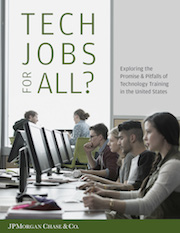
In the past few years, training programs promising on-ramps to high-paying tech jobs have sprung up across the country, drawing attention from the media, government leaders, and the general public. The rapid growth of these new models for tech training – often designed to fill the projected growth in information and communication technology (ICT) jobs – raises questions about how best to classify and understand these programs and their role and value in workforce development more generally.
This report examines the reasons for the tech training hype and proposes a taxonomy of training programs, cataloging best practices from each program type. The report also identifies challenges that organizations, employers, and the government will need to address to ensure these expanding programs accurately meet market demand and look to the future of tech training more generally.
Wells Fargo is donating $300,000 from the Wells Fargo Foundation to support three organizations providing urgent relief in Puerto Rico following Hurricane Fiona. The funding to the Hispanic Federation, SBP, and World Central Kitchen will focus on necessities like meals and supplies as well as resources for rebuilding efforts.
"We understand the urgency when natural disasters hit – especially in Puerto Rico, where communities are still recovering from Hurricane Maria," said Otis Rolley, president of the Wells Fargo Foundation and head of Philanthropy and Community Impact. "At times like this, our company supports the resilience of Puerto Rico and is quickly deploying resources to help meet the many needs unfolding in the aftermath of this storm."
The Geraldine R. Dodge Foundation Board of Trustees met virtually this June and approved $4.3 million in grants to nonprofit organizations focused on the Arts, Education, Informed Communities, and Technical Assistance, as well as new Imagine a New Way grants that address root causes and repair of structural racism and inequity in New Jersey. <BR><BR>
“All that we have learned since embarking on our racial equity journey and through the pandemic is affirming the Dodge Foundation’s path toward a more just and equitable New Jersey, said Tanuja M. Dehne, Dodge Foundation President & CEO. “We are humbled and inspired by the networks, movements, and organizations which continue to meet community needs and build power so that our systems provide opportunities for people of all races and communities to thrive.”