
Site Search
- resource provided by the Forum Network Knowledgebase.
Search Tip: Search with " " to find exact matches.
Alexis Bivens, Vice President of Strategic Initiatives and Managing Director of the Supporting Organizing Work Funders Collaborative, Connecticut Council on Philanthropy, presents the process and progress of how an affinity group transformed into a funders collaborative, how it was resourced, and challenges along the way.
Date: Wednesday, June 18
Time: 8:00 a.m. to 4:00 p.m.
Location
The Palace at Somerset Park
333 Davidson Ave, Somerset, NJ
CNJG’s 2025 Conference for the Social Sector—Stronger Together: Philanthropy and Civic Engagement, features recognized thought leaders, national and regional experts, and community leaders for a full day of connection, shared exploration, thoughtful discussion, and side-by-side learning with philanthropic and nonprofit colleagues.
This year's conference will examine how funders and nonprofits can work together to address and increase civic engagement, focusing on several key areas, including advocacy, local media, participatory budgeting, guaranteed income, public-private partnerships, the arts, and youth education through the lens of civic participation.
Civic engagement is about more than voting or elections. As our colleagues at Philanthropy for Active Civic Engagement (PACE) define it:
“Civic engagement is the process of helping people be active participants in building and strengthening their communities, whether defined as a place or a shared identity or interest. It’s a spectrum of ways people can participate in self-governance, from interactions with government to voluntary associations, and everything in between.”
The opportunity for local communities to convene, learn together, and form partnerships can lead to meaningful action and increased public participation. Let’s explore how philanthropy can impact the social sector by buttressing these connections.
CNJG represents over 130 of NJ’s leading philanthropic organizations – foundations, corporations, and donors. Each year, we present a large-format meeting to include nonprofit partners to discuss big picture topics fostering learning and dialogue between funders and nonprofits.
| Agenda | |
| 8:00 - 9:00 am |
Registration/Breakfast/Networking/Resource Marketplace |
| 9:00 - 10:00 am | |
| 10:00 - 10:15 am |
Networking & Resource Marketplace |
| 10:15 - 11:30 am |
Morning Sessions: The Future of Civic Engagement |
| 11:30 - 11:45 am |
Networking & Resource Marketplace |
| 11:45 - 1:30 pm | |
| 1:30 - 1:45 pm |
Networking & Resource Marketplace |
| 1:45 - 3:00 pm |
Afternoon Sessions: Mobilizing New Jersey |
| 3:00 - 4:00 pm |
Ice Cream Reception/Networking/Resource Marketplace |
Conference Photos

A CNJG corporate member asked for help with the scenario in which a corporate policy of not supporting religious organizations in their grantmaking, causes problems helping during a disaster in an urban or rural area, when the program that is delivering the disaster relief is based within a church. They want to work with those programs (a church serves as the program’s fiscal sponsor) who support efforts for hunger, homelessness, substance abuse recovery, racial equity, etc. as long as they do not discriminate and do no limit it to their own congregations. The request for policy samples to work around this religious organization hurdle as long as there is no discrimination or funding the actual church’s worship, was compelled by CNJG staff and is listed here.
This resource guide includes various virtual volunteer opportunities, additional resources, and best practices for corporate volunteer programs during the coronavirus pandemic.
This resource will be updated, as CNJG and corporate members collect new information and opportunities to share with colleagues.
Philanthropic organizations of all shapes and sizes are well positioned to support Communities for a Lifetime (CfaL). This issue brief explores four roles for philanthropy in advancing CfaL work.
Tax Exempt Organization Search helps users find information about a tax-exempt organization’s federal tax status and filings. You can find:
- Organizations eligible to receive tax-deductible charitable contributions (Pub 78 data).
- Automatically revoked organizations
- IRS determination letters dated on or after January 1, 2014
- Form 990-series returns
- Organizations that have filed a Form 990-N (e-Postcard)
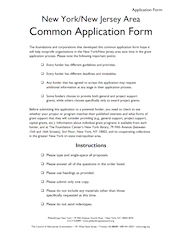
More than a decade ago, the Council of New Jersey Grantmakers and Philanthropy New York spearheaded a project to develop common application and report forms to help streamline the grant application process and ease the often time-consuming grant preparation process.
This application is a four-page form, which includes directions for use, a sample cover sheet, and the common grant proposal guidelines.
The separate Common Report Form follows closely the format of the New York/New Jersey Area Common Application Form.
Information for Grantmakers:
One of the core values at the Trust-Based Philanthropy Project (with whom CNJG partnered on a trust-based grantmaking learning series in the summer of 2021 – read about Part 1, Part 2, and Part 3) encourages funders to streamline their requirements for paperwork from nonprofits. Accepting the NY/NJ Area Common Grant Report Form is one way. Another is to accept reports from nonprofits that they submitted to a different funder.
Recent articles from Vu Le at NonprofitAF.com (We need to have a serious talk about character limits on grant applications and Trust-based grantmaking: What it is and why it’s critical to our sector), Joan Garry in the Chronicle of Philanthropy (A Plea from Community Nonprofits for Investment Equity and less Bureaucracy), and the research project by the Technology Association of Grantmakers (Grant Applications Share 39% Similarity According to New Research by TAG) in the summer of 2021 have re-focused attention on the concept of a common grant application.
CNJG encourages our members to review the application and report form, and consider accepting these forms (or using these questions on your online application / report form) from your current or potential grantees.
CNJG surveyed our members in August 2021 asking if they accepted the NY/NJ Area Common Grant Application and report form. CNJG members can download that report (link forthcoming).
Information for Grantseekers:
Before sending this (or any) application to any funder, be sure to check their specific funding guidelines and application requirements. Some funders require preliminary, additional, or supplementary information. Some funders only accept their own application form. CNJG members are under no obligation to accept either the common grant application or common grant report form.
Additional notes when using the NY/NJ Area Common Grant Application Form:
- Please check with each individual funder if they accept only their own form, the NY/NJ Area Common Grant Application form, or some other form.
- Funding area guidelines still apply. Research each organization’s funding areas to be sure your proposal fits within their guidelines before submitting your application.
- Any funder that has agreed to accept the NY/NJ Area Common Grant Application may request additional information at any stage in their application process.
- Every funder has different deadlines and timetables. Refer to each organization's funding and/or reporting guidelines.
- Do not submit the NY/NJ Area Common Grant Application or report form to the Council of New Jersey Grantmakers. Submit your application directly to the organization from which you are requesting support.
- Questions should be directed to the organization from which you are requesting support.
Strategic asset allocation is arguably one of the most important, yet least advanced, aspects of investing. The Investment Strategy Group (ISG) in the Goldman Sachs Investment Management Division has developed a new approach to strategic asset allocation, which leverages the idea that long-term investment returns derive from multiple distinct sources called “return-generating factors.” This multi-factor approach is designed to help investors better understand the key sources of long-term return across asset classes and to increase the precision of long-term risk and return estimates. It also provides investors with a new way to think about portfolio diversification, allowing them to focus not only on diversification across asset classes but also
on diversification across the underlying sources of return.