
Site Search
- resource provided by the Forum Network Knowledgebase.
Search Tip: Search with " " to find exact matches.
United Philanthropy Forum is committed to advancing racial equity in philanthropy. We provide space for our members to connect, learn and share together on how to effectively address racial equity in their work as philanthropy-serving organizations (PSOs), and works to share our members’ learnings with the broader philanthropy field. As part of these efforts, we are pleased to share case stories from our members about their racial equity work.
Case Story
Funders Together to End Homelessness: A Racial Equity Learning Journey
Funders Together to End Homelessness began its racial equity journey in 2016. Its case story explains how the PSO named racial equity in its strategic plan and embarked on a learning journey together with its board, staff, and members to normalize the conversation about structural and historic racism and how it contributes to disparities in the homelessness system. The story also describes how Funders Together created a two-year community of practice, called Foundations for Racial Equity (FRE), that has been a critical part of its journey, and how its codified its racial equity work through the creation of its Commitment to Racial Equity.
Read Funders Together’s Case Story
Listen to Funders Together’s CEO Amanda Misiko Andere talk about her organization’s racial equity journey on an episode of the ForumNation podcast.
Case Story
Southeastern Council of Foundations: An Experiential Racial Equity Journey
In early 2018, the Southeastern Council of Foundations (SECF) along with its board undertook a racial equity learning journey in order to develop an Equity Framework that would describe and define SECF’s character, what it stood for, and what its leaders were willing to fight for. The decision to develop the Equity Framework was the culmination of years of work. SECF’s case story explains how the organization used data to inform the development of its Equity Framework, created an Equity Task Force to lead the effort of developing a Framework, and engaged board, staff and Task Force members in a racial equity learning journey.
Listen to SECF’s President & CEO Janine talk about her organization’s racial equity journey on an episode of the ForumNation podcast.
The role of corporate philanthropy is at a pivotal point as executive, employee, and customer expectations shift and stakeholders increasingly expect businesses to value and invest in societal welfare. In this rapidly evolving environment, there is opportunity for corporate foundations to reevaluate traditional approaches to grant making, social responsibility, and engagement with counterpart organizations.
The life sciences and health care industry provides an exceptionally compelling illustration of macrophilanthropic trends and possibilities. Although all industries can constructively transform existing corporate philanthropy models, the life sciences and health care ecosystem is experiencing dramatic increases in consumer engagement, perceived social responsibility, and global attention that make more thoughtful, strategic philanthropic investment especially urgent. In this paper, they examine the current health ecosystem, evolving stakeholder expectations, the unique position of life sciences and health care foundations to effect critical change,and alternative engagement models with demonstrated track records of success on an international scale.

Racial Equity Tools is designed to support individuals and groups working to achieve racial equity. This site offers tools, research, tips, curricula and ideas for people who want to increase their own understanding and to help those working toward justice at every level – in systems, organizations, communities and the culture at large.
Public policy is a vital aspect of the work of many of New Jersey's grantmaking organizations and is an integral component of CNJG's programs and member services. CNJG's Policy Committee advise and assist CNJG in identifying issues for potential action.
In late 2023, CNJG’s Board of Trustees approved our first-ever Policy Agenda. The Policy Agenda aligns with CNJG’s 2023-2027 Strategic Plan, specifically Goal #3, Amplify Our Collective Voice. This agenda includes our approach to the work, followed by five policy priorities. Read or download the agenda.
Resource Websites
- United Philanthropy Forum Public Policy Focus
- Center for Non-Profits: Public Policy
- Council on Foundations’ Public-Philanthropic Partnership Initiative
- Council on Foundations’ Advocacy Resources
- Independent Sector: Policy and Advocacy
To learn more about what CNJG is doing to foster deeper relationships between New Jersey grantmakers and public and elected officials in Trenton and Washington, D.C., contact Theresa Jacks.
A corporate member queried the corporate listserve which technology tools they use for their corporate giving system/platform. CNJG compiled the responses and combined it with previous responses from other technology systems queries to create this list of “Who Uses What Technology Systems.” If your organization is not listed, please email the names of those systems to Craig Weinrich.
A Framework for Change
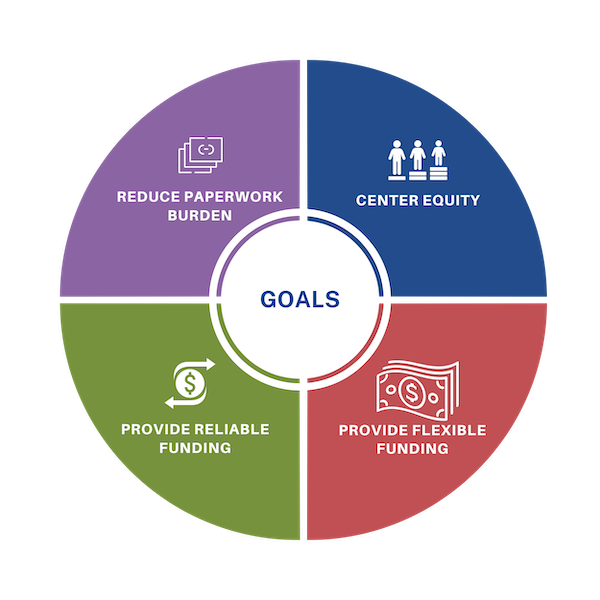
The Doing Good Better Steering Committee encourages funders to focus on and advocate for four (4) changes that can make an immediate difference in addressing power dynamics between nonprofits and funders and maximizing nonprofit impact. These goals are aligned with Trust Based Philanthropy, and are interdependent; when combined, they foster equity and a spirit of mutual trust between grantmakers and nonprofit partners. For more details about a specific goal, click on its individual goal link below.
• Goal 1: Center Equity
• Goal 2: Provide Flexible Funding
• Goal 3: Provide Reliable Funding
• Goal 4: Reduce Paperwork Burden
Self-Assessment/Reflection Tool for Funders
Philanthropy and Nonprofits for Greater Impact: The “Doing Good Better” Blueprint Video
A CNJG member queried the Health & Aging listserves asking for sample letters of inquiry. This document includes a few responses from fellow members. If you would like to add yours to this list, please email us.
"Co-Creation" is a case study about the Connecticut Early Childhood Funder Collaborative, a project of the Connecticut Council for Philanthropy. The case study, written by Patricia Bowie, examines co-creation, an emerging systems change collaboration model which grew out of a funder-and-state partnership. This unique partnership led to the creation by executive order of a new and independent Office of Early Childhood, which was formally approved by the Connecticut State Legislature in 2013. The companion piece, "Taking on New Roles to Address 21st Century Problems," looks at co-creation from the perspective of a regional association of grantmakers.
The Connecticut Early Childhood Funder Collaborative comprises 14 funders from around the state who bring many years of experience in supporting and operating programs that serve the needs of children and families.