
Site Search
- resource provided by the Forum Network Knowledgebase.
Search Tip: Search with " " to find exact matches.
In light of the many recent executive orders and policy shifts, and the impact they’re having on our nonprofit community, the Grunin Foundation is organizing a virtual Monmouth-Ocean Roundtable of Funders (MORF) call. This will be an informal space to discuss what we’re hearing from our partners on the ground, share information about emergency funding foundations may be setting up, and highlight some potential state-wide initiatives in the works. It’s crucial that we all stay in touch, share insights, and continue supporting our partners in Monmouth & Ocean counties (and beyond). We hope you can join us!
CNJG is pleased to offer a new member benefit: ValuesAdvisor. Many foundations now recognize that the investments made from their corpus have the power to support their mission, but don’t know how to take the first step: finding a trusted financial advisor with the right expertise. We now offer you free access to ValuesAdvisor, a nonprofit, online, searchable database of peer-recommended financial advisors who have the expertise you need. You can learn more about the platform by watching this short, 3 minute video. In this webinar with ValuesAdvisor Co-Founder Kate Simpson, you will learn about how the platform can be used to further your mission (climate, DEI, place based, etc.).
This webinar pairs nicely with CNJG’s Impact Investing Bootcamp series.
COST: Free for CNJG Members
Webinar Video
In this webinar presented by Grantmakers Concerned with Immigrants and Refugees, funders will learn from experts on the ground about their efforts to champion universal representation and how philanthropy can resource and support their work.
Universal Representation–as a principle and policy objective–ensures that every person, regardless of immigration status, has access to due process. Having access to legal representation makes a sizeable difference in an individual’s case. For example, asylum seekers are five times more likely to win their case for asylum if they have legal counsel. Yet there continue to be systemic inequities, with upwards of 70% of immigration cases lacking legal representation.
Not having an attorney has also been shown to have significant negative effects on the health and well-being of immigrants and their families. Areas of impact can include loss of income, degradation of mental health, and loss of access to medical care. Although having legal representation does not guarantee the outcome of a case, it can reduce harm and ensure that the dignity of individuals is protected.
Across the nation, organizations at the local and state levels are using a variety of tools and approaches to advance the goal of universal representation. In this webinar, funders will learn from experts on the ground about their efforts to champion universal representation and how philanthropy can resource and support their work.
COST: Free for CNJG Members and Non Member Grantmakers
The New Jersey Council for the Humanities (NJCH) is pleased to announce that we have awarded $402,514 in grant funding to 33 organizations across the state for Spring 2022. These awards cap off a banner grant cycle which saw the largest-ever response to an NJCH call for applications, with 83 Letters of Intent submitted earlier this year. The high demand for funding reflects both the robust activity of the cultural sector and the need for ongoing support in that sector, as we emerge from the COVID-related challenges of the last few years.
The grantees’ projects reflect the creativity, excellence, and lifelong learning that public humanities programming contributes to New Jersey’s cultural and civic life. NJCH’s awards include Incubation Grants, which help organizations plan, research, develop, and prototype public humanities projects and events; Action Grants, which help organizations implement a wide array of humanities-based projects, including public programs, exhibitions, installations, tours, and discussion groups; and Seed Funding, a brand-new award type that recognizes promising applicants from the Action and Incubation award pools and supports them in building greater capacity to do high-impact public humanities projects.
“From telling underrepresented stories to exploring new modes of audience engagement as we emerge from the pandemic, the new grantees’ projects speak to the astonishing breadth and depth of public humanities work in the state,” said NJCH Executive Director Carin Berkowitz. “NJCH’s grantmaking not only highlights those who are already doing exemplary work in the field, but also supports those organizations and communities that traditionally have less access to the public humanities. This approach ensures that New Jersey’s cultural sector will continue to thrive—now and well into the future.”
Confounded by what to do and how to be in your role right now? What does it mean to be focused on a vision of racial equity, well-being, gender justice, economic health when people, institutions, and the systems that have allowed most of us to at least limp along are literally under attack?
With manufactured chaos causing increased threats and real impacts to our safety, our communities face even greater challenges in understanding how and where to strategically invest time, money, and energy. Part presentation and part experiential workshop, this mini-lab led by Change Elemental is designed to meet this moment by supporting us to move in complexity and chaos toward visions of a more just and safer future.
Participants will be invited to learn more about and/or deepen your practice of:
Advancing liberation and sovereignty
Sharing leadership and power
Valuing multiple ways of knowing
Creating space for inner work
Influencing complex systems change
Working with real-life examples, we will dive into what a future of liberation and sovereignty---a future that centers interdependent, whole people and whole communities---looks like and how we might be in support of nonprofits who are actively engaging in the strategies of blocking attacks, building power, cultivating belief, and bridging communities.
Whether you are an evaluator seeking to disrupt existing mental models for evaluating strategy or measuring impact or you're a program officer seeking ways to disrupt power dynamics and build meaningful partnership within the communities you serve, this experience will lead to specific actions for moving effectively with purpose in this moment.
What will I learn?
Session participants will leave with:
New frameworks and ideas for applying them to advance a liberatory future in complexity and chaos
A guiding question and tools to support ongoing experimentation
A taste of what practicing liberation and sovereignty can mean, be, and feel like
A call to support more spaces rooted in being in healthy, continuous, and mutually accountable relationship with self, each other, and the more than human world
Speakers
Aja Couchois Duncan, Senior Consultant, Change Elemental
Elissa Sloan Perry, Director, Prefiguring Futures, Change Elemental
Jess Solomon, Principal, Art in Praxis (former senior program officer, Robert W. Deutsch Foundation)
Trish Adobea Tchume, Vice President, Robert Sterling Clark Foundation
Who should attend?
All interested funders, regardless of roles. What to expect: presentation, practice, followed by panel discussion.
Cost: Free for CNJG Members
Presented by Philanthropy New York
Nonprofits can and should play an active role during elections, particularly by educating and activating voters. However, with important local, state and federal elections coming up this fall, nonprofits should take the time to remind their staff about appropriate activity during a political campaign or at any other time. This overview developed by Donors Forum provides important tips and examples of activities that are permissible for nonprofits during an election cycle.
- Frequent moves are the most significant barrier to academic success, as they disrupt both students and teachers. Students on the move need extra time and attention to get caught up, requiring teachers to spend more time with those students.
- Students who are unable to find stable shelter have difficulty meeting state or district mandates regarding the number of days they must attend school to stay enrolled.
- Often, the slow transfer of student records, along with differing course requirements from school to school, complicates the accrual of sufficient credits for homeless students to be promoted and receive a high school diploma.
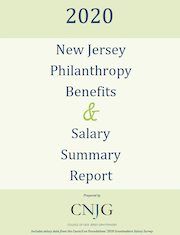
The 2020 New Jersey Philanthropy Benefits & Salary Report provides a valuable benchmarking resource. Developed and compiled for CNJG members exclusively, the report presents comprehensive benefits data specific to New Jersey's grantmaking community, alongside data from the Council on Foundations' annual salary survey. Produced every three years, this benchmarking report is a highly valued benefit of your membership in the Council of New Jersey Grantmakers. Thank you to the CNJG members that completed the benefits survey earlier this year that enabled us to produce this report.
The first section, 2020 Benefits Summary Report, includes benefits data for the 2020 calendar year and covers employment, leave benefits, insurance benefits, and more. We are delighted to also present for the first time in this triennial report, demographic data on the boards and staffs of those that responded. The second section, 2020 Grantmaker Salary Tables: New Jersey, Mid-Atlantic and National Data provides data on compensation across a wide range of positions and grantmaking entities. Thank you to the CNJG members that completed the Council on Foundations’ annual survey on salaries that enabled us to produce this section of the report.
Eastside High School in Paterson sits in the middle of a struggling neighborhood, in a city where 25% of the residents are living below the poverty line, according to the 2020 U.S. Census.
Paterson’s poverty rate is more than twice the state average of 10%, which makes the school, built in 1926, a refuge — and now a resource.
On Thursday, Montclair State University president Jonathan Koppell came to Eastside with a $1 million grant and a vision: to make the school into a community hub, offering free meals, health care, and mental health counseling, not just to the 2,000 students, but to their families as well.
The initiative is called One Square Mile, and it is being seeded with a $1 million grant from the Geraldine R. Dodge Foundation. The program was developed by Koppell during his tenure as Dean of the Watts College of Public Service and Community Solutions at Arizona State University, which worked with the Phoenix-area community of Maryvale to address poverty.