
Site Search
- resource provided by the Forum Network Knowledgebase.
Search Tip: Search with " " to find exact matches.
United Philanthropy Forum is committed to advancing racial equity in philanthropy. We provide space for our members to connect, learn and share together on how to effectively address racial equity in their work as philanthropy-serving organizations (PSOs), and works to share our members’ learnings with the broader philanthropy field. As part of these efforts, we are pleased to share case stories from our members about their racial equity work.
Case Story
Funders Together to End Homelessness: A Racial Equity Learning Journey
Funders Together to End Homelessness began its racial equity journey in 2016. Its case story explains how the PSO named racial equity in its strategic plan and embarked on a learning journey together with its board, staff, and members to normalize the conversation about structural and historic racism and how it contributes to disparities in the homelessness system. The story also describes how Funders Together created a two-year community of practice, called Foundations for Racial Equity (FRE), that has been a critical part of its journey, and how its codified its racial equity work through the creation of its Commitment to Racial Equity.
Read Funders Together’s Case Story
Listen to Funders Together’s CEO Amanda Misiko Andere talk about her organization’s racial equity journey on an episode of the ForumNation podcast.
Case Story
Southeastern Council of Foundations: An Experiential Racial Equity Journey
In early 2018, the Southeastern Council of Foundations (SECF) along with its board undertook a racial equity learning journey in order to develop an Equity Framework that would describe and define SECF’s character, what it stood for, and what its leaders were willing to fight for. The decision to develop the Equity Framework was the culmination of years of work. SECF’s case story explains how the organization used data to inform the development of its Equity Framework, created an Equity Task Force to lead the effort of developing a Framework, and engaged board, staff and Task Force members in a racial equity learning journey.
Listen to SECF’s President & CEO Janine talk about her organization’s racial equity journey on an episode of the ForumNation podcast.
ASAE & The Center for Association Leadership's landmark study and publication 7 Measures of Success identified the ability to build effective alliances or partnerships that advance the mission as one of the hallmarks of a remarkable association. But getting a partnership right is an involved undertaking. That's what The Power of Partnership, itself the result of a strategic research collaboration of ASAE & The Center and the U.S. Chamber of Commerce, is all about. The book takes a no-nonsense look at the intricacies of establishing successful partnerships between nonprofit organizations, between nonprofits and for-profit companies, and between nonprofit organizations and governmental entities.
The Inclusive Growth ScoreTM provides local planners, governments and impact investors with a clear, simple view of social and economic indicators for any census tract in the United States.
There is a plurality of definitions of the term systems change, each contextualized within different cultures and purposes. Doing Good Better embraces systems change as an inter-sector process that addresses complex social problems nonprofits and funders confront with collective action centered on equity, mutual respect, and resilience. Systems change refers to changing the parts and their relationships within a system with the understanding that this change will have ripple effects. As grantmakers, we need to create an environment that enables grantee effectiveness, so they can deliver on their mission. Systems change in philanthropy focuses on structures, policies and processes, resources, values, power, mindsets and, infrastructure that is illustrated in three iterative phases. In time, we hope that the application of this model will result in collective impact and a more resilient social sector for all of New Jersey.
The first phase is structural (operational) change, which involves funders adopting new policies, practices, and resource flows. The second phase is characterized by new relationships and connections that emerge from structural change eschewing old power dynamic practices. Finally, the third phase is transformative change, which occurs when change becomes rooted in organizational culture and mores. We cannot underestimate the length of time and learning at each stage. Achieving transformative change can be a long journey, but it is a learning journey. One grantmaker stated, “One change led to another and another, like dominos. I started to see what people meant by systemic change. New energy and excitement surged among us as hope grew and the cloudy vision of what we wanted became clearer and clearer.”
Although the figure below displays the six developmental stages as linear and distinct, change is unlikely to follow a linear path. Any change in a system will seldom stay fixed at one of these stages but rather will shift back and forth from one stage to another on the path toward the ideal state. We believe just one organization can’t shift the conditions that hold problems in place; we all must share the same perspectives and move the sector together and simultaneously. We call for all of those involved in the sector to work together to build a better and more equitable nonprofit and philanthropy system for all New Jerseyans.
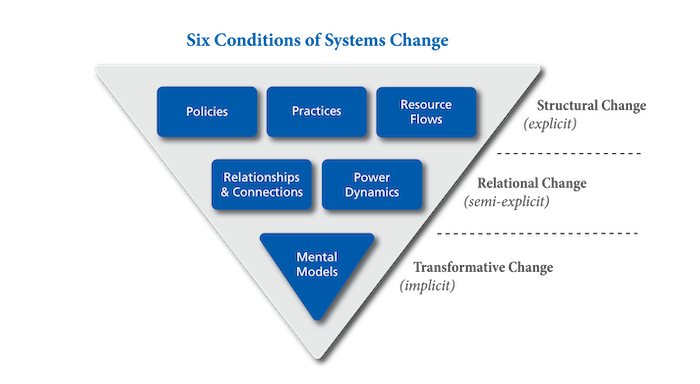
Graphic comes from “The Water of Systems Change” by John Kania, Mark Kramer, and Peter Senge.
Doing Good Better, a partnership of the Council of New Jersey Grantmakers and the New Jersey Center for Nonprofits, is a community of funders and nonprofits taking action against the power imbalances and racial inequities in philanthropy, nonprofits, and government.